

Experience or Efficiency
Your Choice For Buying Books In 2026

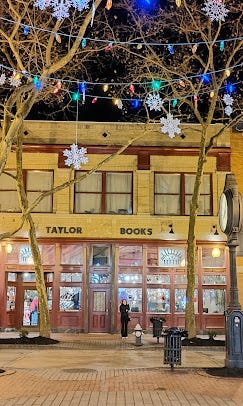
Taylor Books in downtown Charleston, West Virginia, is a great place to visit — which I recently did. On a cold winter afternoon in light snow, the store was full of browsers, and in its café people were schmoozing, tapping laptops, and lingering, in some cases for hours, over a cup of coffee.
Books were arrayed on tables and a tangle of shelves. There was a section for second-hand books and a well-lighted adjoining room for book-related sidelines and gifts, as well as an events space.
Just the place to shop and linger if books and community are your thing.
When my perusing became inquisitive, Dan Carlisle, the owner, introduced himself. It turned out we had a lot to talk about. For an hour so, we meandered around the store. He told me the store was founded in 1995 by Ann Saville, after the opening of a Town Center mall had badly impacted stores in the downtown district.
In 2021 Saville turned over the store, and its lengthy lease, to Carlisle, a long-time employee. She died in September 2025, at the age of ninety; her memorial service was held at the store. Ms. Saville made a good choice. The store seems to have thrived — although bookselling is not the way to get rich quick.
By almost any measure, Taylor Books is what you want in an independent bookstore. It is a cherished destination for all those in the area who consider books and what they represent essential to their lives.
The only shortcoming at Taylor is that the selection of books available in the store for consideration or purchase is limited.
Bookstores have to be curated, meaning that what is for sale reflects the interests and resources of the owner and the staff, along with the square footage of the store itself. So, in the vast universe of what is published yearly and over time, only a tiny fraction can ever be available for sale at Taylor Books.
The recurring bleats about the decline in book variety, quality, and publishing seem to miss how much there is to choose from — in genres as old as time and what is exceptionally popular now, like “Romantasy,” a combination of romance and science fiction selling multimillions of copies.
Carlisle told me that at the urging of his staff, a romance section has been added. Sales are robust.
***************************************
This is where efficiency becomes so much more important in buying books now.
In the long history of the printed word, it has never been easier than it is now to find, buy, and read books. The one-word reason, dreaded by owners of beloved brick-and-mortar bookstores, is Amazon.
When you order a book from Amazon, it will arrive in a day or so, usually at a discounted price. Or if you are among the millions who prefer a digital book on a Kindle or an audiobook from Audible, you can download and start enjoying them instantly.
The irrefutable numbers show that more Americans today are buying books — with efficiency — from Amazon than from all other retailers combined. The question for readers is this: What is more satisfying, the experience of shopping at Taylor Books or at one of the 2,500 other members of the American Booksellers Association or tapping the buy button at Amazon?
From as far back as Amazon’s early years in the 1990s, I have been interested in finding and developing ways for bookstores to compete with the efficiency and access that online retailers guarantee.
I may be well-meaning, but I have not made meaningful headway.
The “indies” will tell you that their website, Bookshop.org, makes it possible to order books to be delivered, with a commission paid to member stores. I read recently that Bookshop.org will be selling downloadable ebooks also.
And audio books are available from Libro.fm or directly from distributors of what were once known as “books-on-tape.”
But here’s the challenge. Until the advent (or onslaught) of Amazon, when most people felt the urge to read a specific book, their thought was, “I’ll see if I can get it.” With the exception of the biggest bestsellers and classic children’s books, this meant making an effort to buy it locally or waiting for your order to be filled and either picked up or mailed (plus postage) to your address.
“Certain and overnight delivery of a book” versus “leaving a store without the book you came in to buy” is, let’s face it, an easy choice for most of us.
Here’s my latest thinking about improving this situation, based on my foray to Taylor Books and my lively exchange with Dan Carlisle. To make clear, Carlisle and other owners of independent stores are heroic in their commitment to books.
I gave Carlisle three books to look up on the database that he and most independent stores rely on for ordering titles. One was a bestseller published last spring by Scribner and two were books published by Rivertowns Books, a small independent publisher whose orders are filled by a major distributor.
None were in the store, although the bestseller had been and sold out. All three were available for delivery from the distributor in a matter of days.
Suppose stores posted prominent notices, on colorful signage, telling customers to ask for ANY and ALL books they want to buy, with the assurance that they could be ordered. I have repeatedly tested my belief that books that carry ISBNs, the universal book identifier (the equivalent of grocery-store barcodes), are for sale everywhere if you ask for them.
Digital books and downloadable audio have been around for decades, but most stores have effectively left the vast majority of those sales to Kindle and Audible. Why?
The explanation is that the indies have not found digital and audio sales significant enough to be worth the challenge of making them easily available. How do they really know?
For me, as just a passing visitor to the store, the concept of ordering any book wouldn’t work at Taylor Books — or at the other independents I visit wherever I happen to be traveling. (Tom Martin’s Book Plate in Chestertown, Maryland, is definitely worth a stop if you are in the vicinity.)
I very much value the experiences available in all these book meccas. I hope that with the right incentives, the owners will make efficiency their goal also. Thirty percent of book sales in all formats are downloadable digital and audio, a market well worth reaching.
My mantra for our times is “Good Books. Any Way You Want Them. Now.” (Or in a couple of days.)
Thanks Peter. I have a list of books that I'm working my way through and the ones that I want to buy (as opposed to getting them from my local library) I'll buy from my local bookstore, Parthenon Books, in Syracuse NY.
"The explanation is that the indies have not found digital and audio sales significant enough to be worth the challenge of making them easily available. How do they really know?" I would argue that you've gotten this backward. It's my feeling that indies have not delved further into digital and audio sales primarily because of technical/logistical challenges that the indies have not found a way to overcome. Libro.fm has proven to be a solution on the audio front but still doesn't come close to the breadth of titles carried by Audible. Bookshop.org may prove to be a help but the indies have their work cut out for them to compete on equal footing with Amazon. I hope they can find a way forward.
Matty Goldberg