


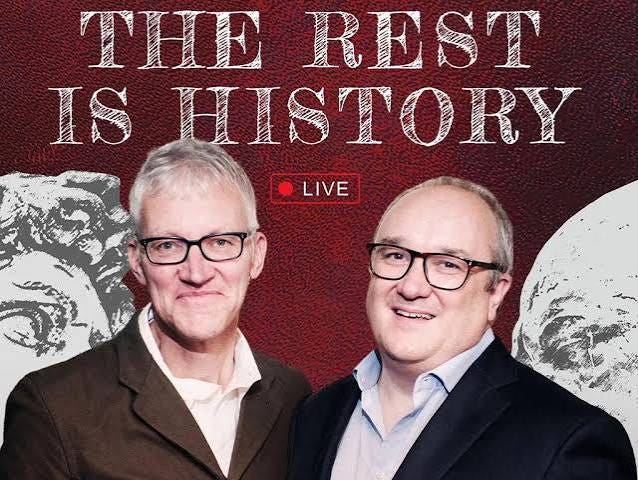
The podcast “The Rest Is History” does for history what “Car Talk,” a much-loved and much-missed NPR program, did for automobile mechanics — a conversation between experts, as erudite as it is entertaining.
The hosts are Dominic Sandbrook and Tom Holland, historians who share the skill of combining storytelling with detail that supports but does not overwhelm the narrative.
The podcast was launched in November 2020, has released roughly eight hundred episodes, and has had tens of millions of downloads. It is a certified blockbuster, as described in this admiring feature in the New York Times.
After multiple recommendations, I started listening to it in the car over the summer and have now added it to my daily intake of added knowledge.
I have been through the Battle of Trafalgar, the Battle of Hastings, the destruction of Carthage, various chapters on the rise and fall of the Roman empire, and, as a sort of change-of-pace, the sinking of the Titanic.
The preponderance of conflict and violence in these sagas is more than coincidental. Civilization is framed by the eternal competition for power, territory, religious and cultural primacy, and by the transience of eras.
One notable aspect of the episodes are apocalypses of one kind or another and the destruction of civilizations — or potentially even the human race. Historical deaths in individual or aggregate numbers are almost always mentioned.
Death counts are also a staple feature of local broadcast news — “if it bleeds it leads” is the mantra — while mayhem and annihilation dominate on the movie screens, especially over the summer.
Children in the 1950s (I was one) were trained in “duck and cover” school drills in preparation for a nuclear attack. We wore dog tags with our names on them. Civil Defense shelter signs were everywhere.
The potential for a nuclear war seems to have receded over the decades, although the amount of weaponry maintained by the United States, Russia, China, and a half dozen other nuclear powers is massive. The arms control treaties that have been negotiated, beginning in the 1960s, have largely lapsed or have been overtaken by real and prospective nuclear proliferation in, among other places, North Korea and Iran.
In 2026, the probability that artificial intelligence agents could bring about the end of humanity has been estimated at a 10 percent likelihood. Regulation of this phenomenon has yet to be established by governments or by the companies that have developed what amounts to weaponry.
So the civilizational peril and violence that represent so much of the content of “The Rest Is History” reflects reality.
And yet history also provides a timeline of progress. Over the centuries, the conditions of life have evolved for the better in almost every respect. One of my favorite lines about these improvements is that among the greatest achievements in medical science was soap and water for sanitation, a very long time ago.
We know so much about the past because we have developed increasingly sophisticated ways of preserving the record. AI seems to be the latest iteration of this, perhaps further than it will turn out to be safe to go.
One of the reasons that Sandbrook and Holland are so popular is their ability to relate history to the present — how, for example, the politics of imperial Rome align with the twenty-first century.
They remind us that scandals, corruption, rage, and sex have deep roots in human nature. So it is that violence also is a recurring theme down the generations. In many places (although not yet in the Darfur region of Africa), terrifying men on horseback have been replaced by swarms of drones that kill with little risk to those deploying them, progress of a sort.
Podcasts are proof of continuity in history. Listening to people talking and telling stories is an experience as old as time.
Events then and now are on a continuum. “The Rest Is History” makes that connection, and it is definitely working well.
