

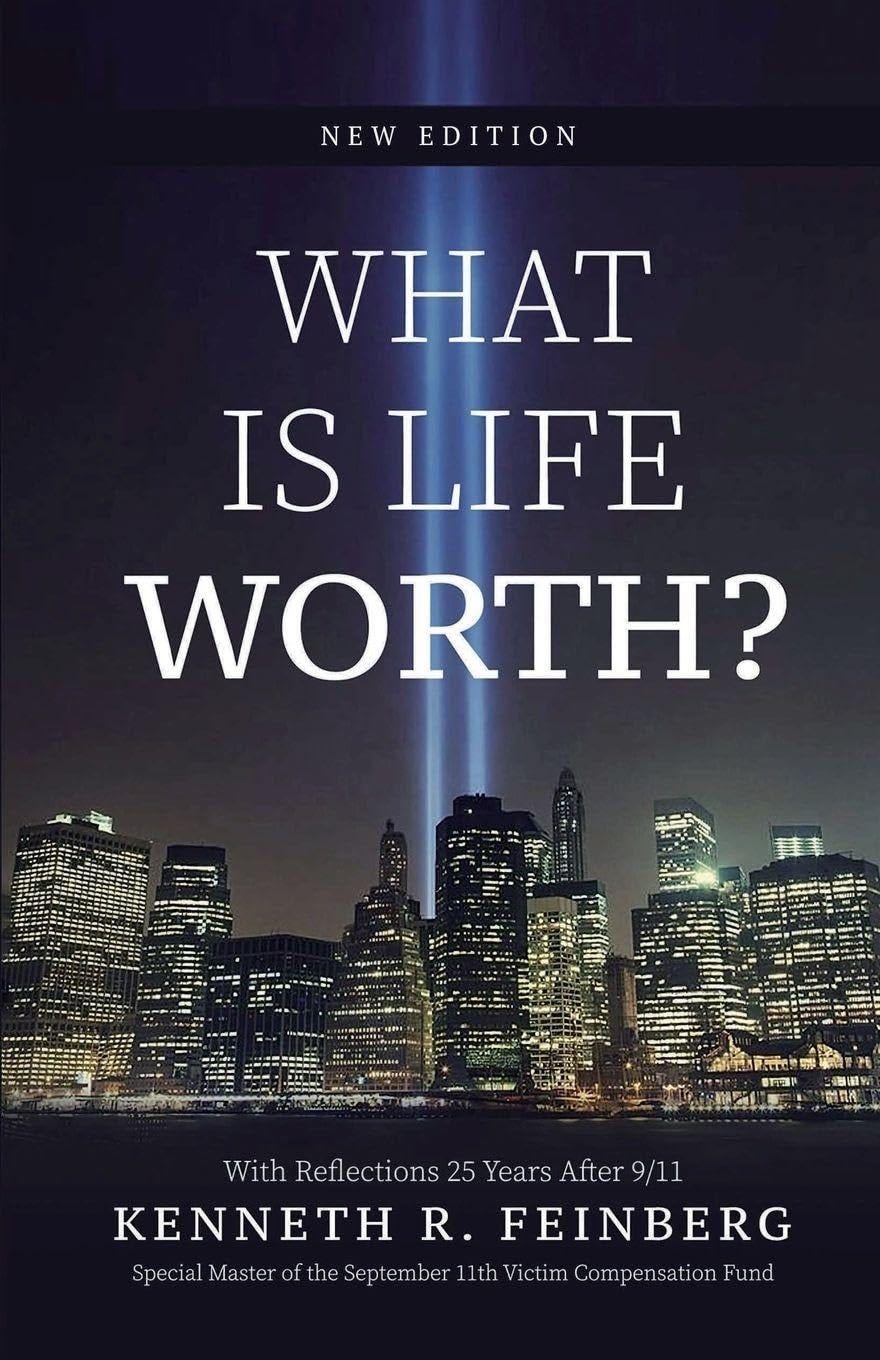
Kenneth R. Feinberg was the Special Master of the Victim Compensation Fund established in the immediate aftermath of the terrorist attacks on September 11, 2001. Feinberg’s book “What Is Life Worth?” has been rereleased featuring his reflections a quarter century after the events. Here is a commentary that Feinberg has written to coincide with the occasion. Please share it widely.
Just thirteen days after the September 11, 2001, terrorist attacks, the Congress and the Bush Administration - working together with a common purpose - established an unprecedented victim compensation fund for over 5,000 victims and surviving family members of the attacks. This compensation was funded entirely by public taxpayer money and sent an important message to the victims and families – you are not alone. The American people would stand united in offering generous compensation and support to innocent victims of terror. “There but for fortune” was a guiding Fund principle. Anyone could be a target of terrorism. Death and physical injury were random results of terrorists attacking individuals who were simply in the wrong place at the wrong time.
American citizens, foreign nationals, even undocumented workers were all eligible for compensation. Ultimately, over $7.1 billion was paid by the US Treasury to the victims and family members.
A critically important feature of the Fund permitted any surviving victim or family member the option of a private meeting with me. These meetings were entirely voluntary and confidential, held behind closed doors. No subject was off limits.
Over 1,500 individuals opted to meet with me or, because of the sheer volume of requests, with a member of my staff. Very few of these meetings focused on compensation. Instead, the confidential meetings provided victims and their families an opportunity to express raw emotion - anger at life’s misfortune and finger pointing at the government for failing to prevent the attacks. Others focused on their frustration and grief that a loved one had perished under the most horrific circumstances without even an opportunity to say goodbye. Others came to the meetings with a different purpose – to validate the memory of a lost spouse, child, or sibling. In these cases, individuals presented me with personal memorabilia including photographs, medals, diplomas and even home movies of happier times. The memorabilia filled my office.
These meetings were extremely emotional, chilling and debilitating. Recesses were frequent and necessary to provide the survivors and families an opportunity to regain their composure. I, too, welcomed the pause before hearing additional stories.
The actual meeting testimony itself bears witness to the emotional atmosphere:
· “They finally found him. They brought his remains home. They had a big funeral service, memorial service and they buried him. Three months later they found that they hadn’t buried him. It was the wrong individual they had been provided. They had to disinter and give to the family the proper remains and then bury him again.”
· “I’m angry. I’m angry. I have to be honest, I am angry with our country also because they let this happen. My beautiful boy was cremated because of them. I never got anything back… if somebody took your child and blew them up and you didn’t have a piece of a fingernail left, how do you live – how do you go on? I’ll never be the same.”
· “She taught me to realize that every day is a choice to be happy or not. She taught me to be present in each moment. They aren’t all meant to be happy. But sadness is as much a part of life as joy, and so the sadness that I feel at losing her is almost equivalent to the joy that she shared with me while she was alive.”
· “The loss is not the greatest for me; I had five years with my husband. I remember having so many dreams where he would come and take our son from me and my husband would say ‘just give me five minutes. I just need five minutes and I’ll give him back.’ And if I could give him five minutes, I’d give him five minutes, because he never had a chance to know his son.”
· “My wife called and I said, ‘Well, thank God, you are okay.’ She said, ‘Well, no, I am not.’ As HR Director, she basically took the responsibility to make sure that everybody got out. She had made a 911 call two minutes before the building fell saying there are eight people up here and, you know, we need to get down. She was still doing her job.”
· “The only thing that disturbed all of us was the fact, in actuality, there was nobody to save. There was nobody to save. What we had been trained to do every day – to mend bones, to patch up wounds, and treat people, that was not to be that day. And it’s amazing to me to think how many EMTs have left the field since then because they couldn’t handle what they remember of that day and have gone on to other things.”
These hundreds of individual stories, spread out over the thirty-three-months of the 9/11 Fund, were critical to success. The individual meetings offered victims and their families an opportunity to express their innermost feelings out of the public eye. They focused on the personal impact of the tragedy and how it affected both their lives and the lives of family, friends, and neighbors. The meetings afforded individual claimants an opportunity to meet with the one government official responsible for administering the program. I believe these meetings helped the victims begin the slow, uncertain healing process by moving forward as best they could.
But these Fund meetings had an important second purpose – they reinforced the idea that America was one community writ large, united in demonstrating support for the 9/11 victims especially in times of tragedy. The Fund reaffirmed the charitable character and empathy of the American people and offered proof of the Nation’s support. In doing this the Fund played a significant role not only in helping individuals cope with tragedy but, as importantly, promoting a type of national healing. In so doing, the Fund has earned a prominent place in American history offering a sense of hope to both victims and our Nation in dealing with the tragedy.
Today, the faith I had twenty-five years ago in embracing the idea of one America, one national community, especially during times of crisis, has succumbed to a new reality. The faith and optimism our Nation exhibited in creating the 9/11 Fund stands in sharp contrast to today’s America. The proclaimed objectives of the 9/11 Fund now ring hollow. Instead, today the 9/11 Fund is either forgotten, ignored or even cited in a perverse way to justify the Trump Administration’s Anti-Weaponization Fund and its shameless raid on the US Treasury.
But I remain hopeful that better days will return and we will once again point with pride to a critical time in American history when the Nation reaffirmed its first principles and exhibited the public character that resulted in the creation and success of the September 11th Victim Compensation Fund.

It was quite a day.....I was business editor of The New York Daily News .... we had just finished running a multi-part series on Larry Silverstein inking a 99-year lease on the entirety of the Twin Towers for $3.2 billion ($5.8 billion in 2026 $s) ... our real estate reporter who wrote the series had to WALK to the office on West 33rd Street from his home in Broklyn since all bridges & tunnels had been sealed ! Fun was getting the delivery trucks through the Lincoln Tunnel from the printing plant in NJ (with police escort) !
I was a lucky one. Out of town that day.