

Twarda 28
Part One: The Building That Survived the Ghetto and the War

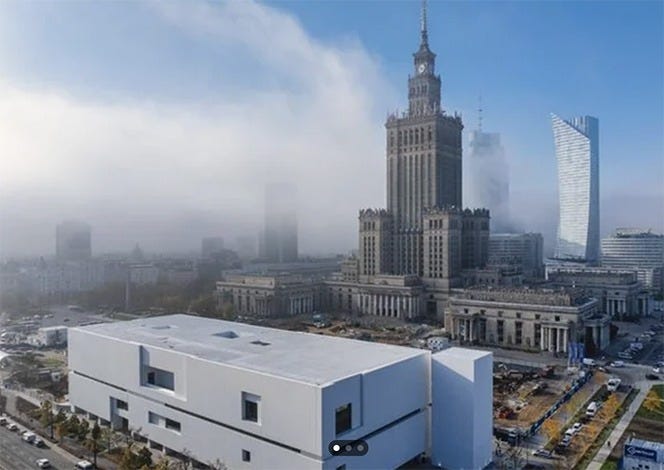
The all-white Museum of Modern Art . . . gleaming beside the hulking Stalin-era Palace of Culture and Science. . . . For decades, the Polish capital has been seen as pragmatic rather than magnetic . . . it demands to be seen anew.
*******************
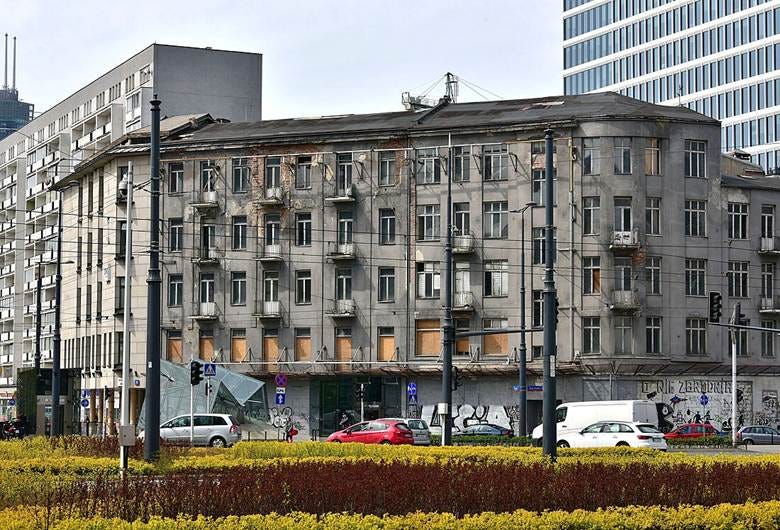
This building, close to the museum and the palace in the center of Warsaw, is called the Lieb Osnos Tenement. In the process of publishing In the Garden of Memory about my mother’s family, I began to learn more about my father’s family, who had built it in the early years of the twentieth century. There were fifty apartments, eleven stores on the ground floor, and a doctor’s office.
I found out that it was the only building in what was known as the “small ghetto” that remained standing after the end of World War II. And in 2019 it was included in the official Registry of Objects of Cultural Heritage, protecting it from being demolished.
I assembled a history of the building and the family that owned it, including the discovery that my grandmother Rachela Olga Osnos did not die before the war, as I had always believed. She died in the ghetto or in a concentration camp, as did so many others in the family.
Their fates were not really a secret. But except for the gravestone my father had erected in Warsaw’s Jewish Cemetery decades after the war, the subject was never discussed in any detail by my parents, and I never asked for more. Here is what the gravestone says:
LIEB OSNOS
CITIZEN OF WARSAW
LIVED 67 YEARS
DIED 20.VII.1939
RACHELA OLGA OSNOS
CHILDREN
JAKUB MARIA ANNA
MAREK FRYDA
GRANDSONS AND GRANDDAUGHTERS
DIED
A MARTYR’S DEATH
MURDERED BY
NAZI BARBARIANS
1940-1944
**************************
The building is badly in need of renovation, shuttered completely and adorned with graffiti, with bits of plaster falling on passersby. No funds have been available to get this work started.
I had only been vaguely aware of the building. In family papers, there was correspondence in which my father was approached by lawyers in the 1960s, urging him to seek some compensation for the state seizure. That did not happen.
Against all odds, the building was not destroyed by bombings in 1939 as the Nazis occupied Poland or by the continued barrage of attacks as the war progressed. In the severe housing shortage in Warsaw after the war, it was resettled by tenants. The last residents left in 2009 because the building was no longer safe.
Controversies surrounded what had become a decrepit concrete eyesore until it was registered as a monument by the authorities as a vestige of pre-war Warsaw and the thriving Jewish community that had been virtually annihilated.
On a visit to Poland in the spring of 2025, I mentioned to the concierge at the Hotel Europejski, itself an elegantly refurbished remnant of pre-war café society, that I was planning to visit Twarda 28, showing him a photograph that I had found in, of all places, a Wikipedia entry.
Startled and clearly impressed, he called over a colleague and exclaimed that I was of the Lieb Osnos family. That was when I realized that while this structure may be shabby and uninhabitable, it was symbolically significant. I decided to find every shred of information I could about what it was like when my father’s family owned it.
I was shocked to realize for the first time that my grandmother and most of my aunts and uncles had disappeared after the war started and were Holocaust victims. Because in my mother’s family everyone had managed to survive, I chose to think that my close relatives had been exceptions to the greater catastrophe.
My father, Josef, as formidable in his way as the family building, never reflected on the tragedies, leaving only the symbolic gravestone in a prominent place at the front of Warsaw’s Jewish Cemetery.
********************
Over the years, Polish publications have written about the building’s history, reporting on its symbolic importance and/or complaining that it is now a blight in the midst of skyscrapers and high-end retail.
The most detailed description was provided by Urbex Travel, a website run by a couple who describe their “passion” as visiting “abandoned places . . . houses, mansions, warehouses, factories and many others.” Their portfolio of interior photographs shows that the apartments were spacious and ornamental, homes for families with the means to live in comfort.
Quoting from a book called Roots of the City: “In 1936, the building generated over 5000 zlotys in rental income. The owner charged 180 zlotys for a four-room apartment, with a kitchen and bathroom, and 19 zlotys for a single room apartment in the basement. The ground floor housed numerous shops, a butcher shop, a dairy shop, a hairdresser’s salon, and a wine shop.” A document written after the war by a lawyer in Canada who had represented Lieb Osnos reported that there were fifty apartments in the building and eleven stores on the ground level.
The doctor’s office and apartment belonged to my father’s oldest brother, which my mother described in her memoir of that period as “beautifully furnished.” Of particular note,” she wrote, there were “green velvet chairs” in the dining room. The premises were on the first floor, which meant that they were a relatively safe place during the Nazi bombing in 1939.
Urbex’s account says the building was a “center of Jewish life and business, and everything was owned by Lieb Osnos,” who had made an apparently prosperous living by “trading textiles.” This had enabled him in around 1910 to buy the land and develop the property.
The technical description of the building from Urbex said it had “architectural features typical of a 19th century tenement house,” which in modern terms indicates that it was not a single-family mansion but rather the residence of a successful upper-middle-class businessman and his family.
A report by Professor Jakub Lewicki, the Mazovian Voivodeship (the Warsaw district) Conservator of Monuments, calls the building a “priceless relic of its heyday . . . a valuable document of the history of old Warsaw, particularly the history of the Jewish community and the ongoing stylistic and formal transformations, which are clearly visible within the confines of a single building.”
Lewicki wrote: “Despite the damage sustained during World War II . . . the building possesses significant artistic value . . . particularly noteworthy are the exceptionally rich stucco decoration and the introduction of parquet flooring in most rooms . . . and above all the entrance doors and joinery inside the apartments.”
The windows have been shuttered with concrete. Of course, I was moved to see it as an uncanny connection to my ancestors, but to other passersby it would be just another glimpse of a world that had been destroyed between 1939 and 1945.

Good to know something from before the war is being saved.