

Yes, Artificial Intelligence Is a Very Big Deal...
So Are Teachers in Classrooms.

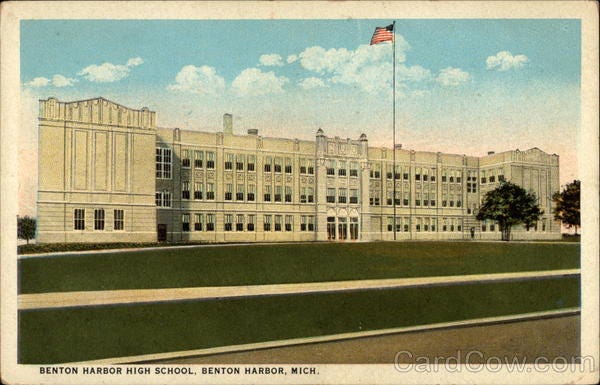
BENTON HARBOR — The national teacher shortage is hitting Benton Harbor Area Schools hard, with half of the district’s classrooms not having certified teachers.
— Louise Wrege, The Herald-Palladium, Oct. 16, 2025
Benton Harbor is a small city on the shores of Lake Michigan in the southwest of the state, known mainly for its intractable social and economic problems.
The Herald-Palladium, the local daily, reported that Proximity Learning, a company based in Austin, Texas, had signed a $1.1 million, ten-month contract with Benton Harbor’s school board.
Sheila Dorsey-Smith, the director of human resources for the school district said that eighteen core teacher positions needed to be filled, many of them math and science positions in the middle school and high school, and the district had chosen to fill them virtually, through the services provided by Proximity Learning.
Whatever the other factors, shortages are doubtless greatest where salaries are too low, given the rising costs of housing, health care, and child care. Teachers are professional educators. Available statistics for Michigan show a pay scale starting (before taxes) at an annual salary of about $40,000 and reaching $70,000, except in the wealthiest districts. Can anyone really contend that this is enough?
The concept of virtual classroom teachers as a solution was new to me. I wanted to know more and sought out experts.
How widespread is it across the country? What does the data show about how this practice impacts students? And with an administration in Washington, D.C., in the process of abolishing the Department of Education, does our national leadership recognize or care about the issue?
An Associated Press story during this fall’s government shutdown titled “Government Shutdown Offers Schools a Glimpse of Life Without an Education Department” declared, “Schools and states are on their own. That’s the vision President Donald Trump has promoted since his presidential campaign.”
*************************
Benton Harbor is adjacent to St. Joseph together they are known as the “Twin Cities.”As Alex Kotlowitz writes in his book The Other Side of the River,. As long ago as 1989, Money magazine hyperbolically “anointed the Benton Harbor metropolitan area, which includes St. Joseph, the worst place to live in the nation. Everyone, of course, blamed Benton Harbor for the rating.”
Then as now, “St. Joe” residents are overwhelmingly white. Benton Harbor is overwhelmingly Black, with a minority of newer Hispanic immigrants. Typical family income, Kotlowitz wrote when his book was published in 1998, was one-fourth of that in St. Joseph. That gap remains. Data USA reports that in 2023 median household income in Benton Harbor was $29,652. The comparable figure for St. Joe is $77,765.
An extensive Time magazine essay by Kevin Carey, the director of the Education Policy program at New America, reported that according to the nonprofit Ed Build, the border between the two cites’ school districts is “one of the 10 most economically segregated school boundaries in America.”
*****************
I was referred to Dan Goldhaber, a professor at the University of Washington, an expert on educational data, for a national assessment of virtual teaching. Goldhaber said that the practice is mainly used in rural areas to fill specific needs — where, for example, four students want advanced subjects and no local teacher is qualified enough.
Goldhaber said he was not aware of any recent comprehensive survey of virtual teaching, but on balance even a remote teacher is better than no teacher at all.
A lengthy Wall Street Journal piece from 2023 reported that “virtual teachers are beaming into thousands of classrooms this school year from Nevada to Alaska to New Jersey in subjects such as world languages, special education, science and math.”
The Journal describes a teacher who spent a semester working for Proximity Learning, “trying to teach an eighth-grade life-skills course in Texas. The classroom had no dedicated laptops, and there was never an adult present, . . . so each day she logged on and hoped students would find a way to tune in via their phones. ‘It was kind of soul crushing,’ she said.”
Conditions doubtless vary across the country, but everyone I talked to was startled to hear that Benton Harbor needs to use so many virtual teachers. Benton Harbor is among forty-seven school districts in the state where the Michigan Department of Education is in an agreement to improve student performance. Prior to that, the state had to bail out the district’s debilitating debt problem.
Kotlowitz, who is still following developments in Benton Harbor and St. Joseph, pointed to another factor that has impacted the schools: contiguous transfers, which enable students to switch districts or attend charter schools. He and others have said that it is the better students who are likely to choose this option.
School enrollment in Benton Harbor has dropped significantly over the years. In the 2013-14 school year, the number of students in the district was 2,689; in 2024-25 it was 1,253. According to the Herald-Palladium, the state provides $9,608 for each student, so the loss of enrollment means a significant loss of support, adding to the downward spiral.
**********************
So, what’s to be done? The obvious answer is money. As I understand it, over the years various projects to upgrade public facilities in the city have been developed and funds allocated by local and state government, some developers, and businesses. The largely abandoned downtown now has an Arts District, for example. Residents of both cities want outsiders to know that their long-term hope is to improve Benton Harbor in all respects.
On a visit to Benton Harbor High School, I saw the trophies and the black-and-orange trappings of “Tiger Pride,” the school’s colors and motto. Whatever the infrastructure needs in the schools may be now, the greater concern has to be the astonishing lack of qualified teachers in the district.
To address this situation, it is urgent for the district to find the money for salaries and benefits that make the jobs and careers appealing. Modern Michigan is awash in taxable cannabis, Native American casinos, and booze. What was once thought to be sinful now produces cascades of cash. Demand more from those establishments.. Would there be political obstacles? Of course there would be.
Providing educational quality in places like Benton Harbor is essential if the deeply ingrained crises of life there can ever be resolved. Filling classrooms with stopgaps — virtual teachers and substitutes — is a symptom of how bad the situation has become.
The social engineering of racial and economic integration are goals to be honored and implemented. In the meantime, there is incalculable value in certified resident teachers, always on hand, available for assistance, and to the maximum degree possible being treated with tangible (and bankable) respect in the communities they serve.

Is the obvious answer (always) money? Is a school system with fewer than 1300 students viable? You don't have to recall the Conant report to wonder whether a larger, consolidated system would work better. Clearly money would help here, might help somewhat in the short run, but hard to see it as a solution